Spotify Podcast Transcript: Three Measured Transcription Errors
For a Spotify podcast transcript, Reelscriptly works from a local audio or video file you are authorized to process—not from a Spotify link. The examples below show three specific errors from English local-file tests; they are not tests of Spotify episodes.
What we tested
We ran the excerpts below through Reelscriptly’s in-browser transcription tool with English selected. All three are 15-second sections from the same AMI ES2002a meeting recording. Speaker counts are based on the AMI manual annotations.
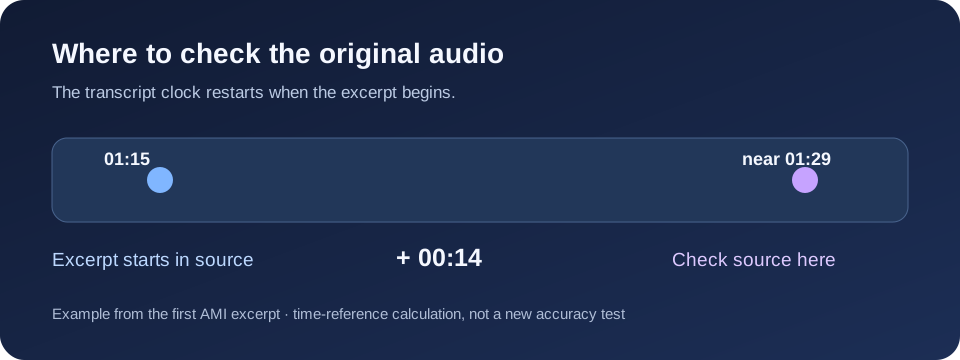
Source time windows refer to the original recording. Timestamps in Reelscriptly output start at the beginning of each excerpt.
| Source | Time point | Duration | Language | Speakers | Manual transcript | Reelscriptly output | What was wrong |
|---|---|---|---|---|---|---|---|
| AMI ES2002a audio | 01:15–01:30 | 15 seconds | English | 4 | “Um I'm Craig and I'm User Interface.” | [00:00:14.000] I am Greg | “Craig” was transcribed as “Greg,” and “and I'm User Interface” was omitted. |
| AMI ES2002a audio | 02:05–02:20 | 15 seconds | English | 4 | “What did you get?” | [00:00:06.179] What did she get? | “You” became “she,” changing who the question addressed. |
| AMI ES2002a audio | 02:35–02:50 | 15 seconds | English | 2 | “you get to draw your favourite animal and” | [00:00:06.419] You got your favorite animal and | “Get to draw” became “got”; “draw” was lost, changing the meaning. |
What these observations establish
These are three excerpt-level observations: a name changed, a pronoun changed, and a verb phrase was lost. They do not establish an overall error rate, an accuracy percentage, or how the tool performs on Spotify episodes.
The source audio is an AMI meeting-corpus sample, not a Spotify recording. See the AMI corpus information and the sample attribution and license notes.
How to check these examples
Can I paste a Spotify episode link into this tool?
No. Use an audio or video file you are authorized to process. This page does not test or promise direct import from a Spotify URL.
Which time should I use in the source recording?
The output timestamps are relative to each excerpt, while the table's time windows are positions in the original recording. For the first row, the excerpt begins at 01:15 and the displayed output starts at 00:14, so check near 01:29 in the original audio. This is a time-reference calculation, not a new measurement of transcription quality.
What should I verify before quoting a transcript?
Check the source audio at the cited time and compare the name, pronoun, and action with the generated text. The three examples above show why those words matter; they do not predict how a different recording will transcribe.
Unique material on this page: the three exact local-audio test excerpts—“Craig” → “Greg,” “you” → “she,” and “get to draw” → “got”—paired with their output timestamps and source time windows.