MP3 TO SRT · FILE TESTS
MP3 to SRT: real-file case studies
Answer: An MP3-to-SRT export can miss or misrecognize words even when the tool finishes; compare the recording with the unedited subtitle file and review its timestamps before using it.
These cases preserve the original test inputs, reference text, exported subtitles, dates, sources, and stated limitations. They describe the specific runs shown, not a guarantee for other files.
MP3 TO SRT · COMPLETENESS CHECK
What if the last sentence is missing from your SRT?
Answer: replay the final sentence and compare it with the raw SRT, even when the tool says Done. In this check, the WAV and MP3 exports reached the closing phrase, while the MP4 export stopped after “These words come from”. All three runs completed. This is a reproducible case to inspect, not a claim that changing format fixes every missing ending.
On October 26, 2026, we selected each actual file in the live audio transcription tool, with English and SRT selected throughout. The MP3 was encoded directly from the original WAV, not extracted from the MP4. This is a follow-up to the conflicting MP4 audio and subtitle-track check; the MP4 was genuinely selected and run again today. The tool's code was not changed for this experiment.
The recording and what it was meant to say
Reference: The blue suitcase is in room fourteen. Please keep the receipt with the silver key. These words come from the audio, not the subtitle track.
Microsoft Zira Desktop reads the entire script with one synthetic English voice. The source recording was created locally on October 25. Today's runs test that existing voice in separate files; they are not three independent speakers, new customer recordings, or a public podcast benchmark. FFprobe measured the WAV as 11.012789 seconds and 485710 bytes. The new mono, 22050 Hz, 96 kb/s MP3 is 11.012789 seconds and 133268 bytes. The existing H.264/AAC MP4 is 11 seconds and 108544 bytes, with a separate embedded text track. Its audio-stream duration is 10.959819 seconds.
Original WAV · Actual MP3 input · Actual MP4 input
Three completed runs, three untouched downloads
Run order was WAV, MP3, then MP4, in the same Chrome tab. Each result below comes from that file's new run. We kept the actual downloaded files before selecting the next input. The wording, quotation marks, capitalization, and timecodes are unchanged.
WAV: Done — 3 segments.
Download the raw WAV-run SRT · 227 bytes.
1
00:00:00,000 --> 00:00:03,200
The blue suitcases in room 14.

2
00:00:03,200 --> 00:00:06,360
Please keep the receipt with a silver key

3
00:00:06,379 --> 00:00:10,140
These words come from an audio, not this subtitle track
MP3: Done — 4 segments.
Download the raw MP3-run SRT · 262 bytes.
1
00:00:00,000 --> 00:00:03,200
The blue suitcases in room 14.

2
00:00:03,200 --> 00:00:06,360
Please keep the receipt with a silver key

3
00:00:06,379 --> 00:00:08,560
These words come from "the audio"

4
00:00:08,580 --> 00:00:10,179
Not this subtitle track
MP4 rerun: Done — 3 segments.
Download today's raw MP4-run SRT · 193 bytes.
1
00:00:00,000 --> 00:00:03,200
The blue suitcases in room 14.

2
00:00:03,200 --> 00:00:06,360
Please keep the receipt with a silver key

3
00:00:06,379 --> 00:00:07,519
These words come from
The new MP4 download matches the previous day's MP4 export byte for byte, but today's result is a separate real run, not the old file relabeled as new evidence. The other downloads differ. The WAV reaches the closing phrase in one cue; the MP3 splits it across two cues. Neither is verbatim: both change “suitcase is” to “suitcases” and “the silver key” to “a silver key”. The WAV says “an audio” and “this subtitle track”; the MP3 adds quotes around “the audio” and also says “this subtitle track”. Retaining the ending is not the same as recognizing every word correctly.
Was the browser's decoded buffer only seven seconds long?
No. After the transcription runs, a separate local-only diagnostic selected the same three inputs in this Chrome browser and decoded them with new AudioContext({sampleRate:16000}) and decodeAudioData, matching the live tool's requested decode settings. It did not run a speech model. The page wrote the returned sample rate, channel count, sample count, and duration into its visible result. All three decoded as mono at 16000 Hz:
| Input | Decoded samples | Decoded duration | Last SRT cue ends | Closing phrase retained? |
|---|---|---|---|---|
| WAV | 176204 | 11.01275 s | 10.140 s | Yes, with word changes |
| MP3 | 176204 | 11.01275 s | 10.179 s | Yes, split into two cues |
| MP4 | 175357 | 10.9598125 s | 7.519 s | No |
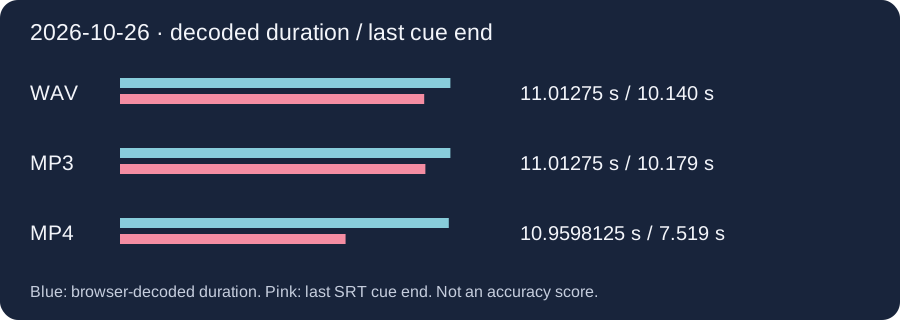
The duration check is arithmetic: samples ÷ sample rate, for example 175357 ÷ 16000 = 10.9598125 seconds for the MP4. Its decoded buffer was therefore longer than the 7.519-second final cue. This rules out the narrow claim that this diagnostic decoder returned only 7.519 seconds of audio. It does not prove the decoded waveform's entire ending was equivalent across formats, isolate why recognition stopped, or measure the ideal final cue boundary. No model or decoder repair was made.
What to learn from the competing workflow
The SubtitleKit audio-to-SRT page, read on October 26, walks through file selection, spoken-language selection, transcription, then reviewing and editing cues before download. It also recommends starting with the original recording. Those are its published workflow instructions, not a same-file output comparison we completed there.
Our earlier MP4 record showed that a file could finish with an omitted ending but did not show the original WAV, an independently encoded MP3, and decoded sample counts together. This article makes the review step concrete: listen to the closing phrase, locate it in the raw export, and compare the actual file-specific result. We did not verify a competitor speed or accuracy advantage, and local processing is not unique to this site.
Questions about an MP3-to-SRT ending
Should I turn my MP3 into WAV if the last sentence is missing?
You can test a WAV copy, but this experiment does not show that converting an MP3 to WAV repairs missing words. Here the MP3 was made from an existing original WAV, not the other way around. Preserve the original, run the actual alternative file, and compare its export before relying on it.
Can I just extend the last subtitle's end time?
No: changing a cue's end time does not restore words that were never transcribed. Keep the raw SRT, replay the end of the recording, and correct a separate copy against what is audible. Do not fill in a sentence merely from the reference script without checking the actual recording.
Did this comparison fix the MP4 transcription problem?
No: the new MP4 run reproduced the same truncated final sentence. The WAV and MP3 runs provide alternatives to inspect for this recording, not a repair or a guarantee for other files. The decode check narrows one explanation but leaves the root cause unresolved.
What is specific to this article: today's three actual selections, uncorrected downloaded exports, the retained and omitted closing phrases, independently measured decoded sample counts, and the explicitly unresolved cause. This is one synthetic recording, with one new transcription run per format today, not a representative accuracy benchmark.
Use the main MP3-to-SRT workflow · Compare the saved-audio workflow · Convert existing SRT and VTT files
MP3 TO SRT · SHORT NUMBER RECORDINGS
Will an MP3-to-SRT export keep a short number sequence?
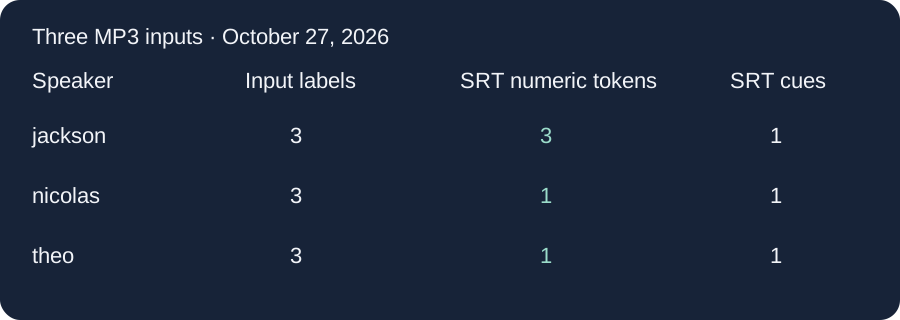
Answer: check every spoken number against the downloaded SRT. In these three real-voice MP3 runs, the jackson file produced “0, 3, 7.”, while the nicolas and theo files each produced only “0”. All runs said Done. A completed export did not establish that the later numbers were present.
Tested on October 27, 2026 with English and SRT selected in our live audio transcription tool. These are newly prepared, licensed human recordings, not the synthetic voice from our earlier tests. This article is a small reproducible check, not an estimate of recognition accuracy or a ranking of accents.
Three files selected in the live tool
Each MP3 joins the same digit labels, zero then three then seven, from one dataset speaker. The speakers are separate recordings, not simultaneous voices in a meeting. We selected and transcribed each actual MP3, then kept its downloaded SRT without correcting the recognized text.
| Dataset speaker | Input duration | Input bytes | Exported cues | SRT bytes | Cue text |
|---|---|---|---|---|---|
| jackson | 4.561406 s | 55841 | 1 | 41 | 0, 3, 7. |
| nicolas | 4.140408 s | 50826 | 1 | 34 | 0 |
| theo | 4.062630 s | 49885 | 1 | 34 | 0 |
jackson: the actual MP3 and SRT
Source-label sequence: zero, three, seven. English, one speaker in this file. Input: 4.561406 seconds and 55841 bytes, measured with FFprobe. The tool returned Done — 1 segments.
Download this MP3 input · Download the untouched SRT
1
00:00:00,000 --> 00:00:04,000
0, 3, 7.
All three labeled digits appear in this one cue. This is not word-level timing: the output groups them into a single interval.
nicolas: the actual MP3 and SRT
Source-label sequence: zero, three, seven. English, one speaker in this file. Input: 4.140408 seconds and 50826 bytes, measured with FFprobe. The tool returned Done — 1 segments.
Download this MP3 input · Download the untouched SRT
1
00:00:00,000 --> 00:00:02,000
0
Only the initial zero appears. The labels for the following clips are three and seven, but neither appears in this exported text. We have not inserted them into the download or extended its cue to imply a complete result.
theo: the actual MP3 and SRT
Source-label sequence: zero, three, seven. English, one speaker in this file. Input: 4.062630 seconds and 49885 bytes, measured with FFprobe. The tool returned Done — 1 segments.
Download this MP3 input · Download the untouched SRT
1
00:00:00,000 --> 00:00:02,000
0
Only the initial zero appears. The labels for the following clips are three and seven, but neither appears in this exported text. We have not inserted them into the download or extended its cue to imply a complete result.
Original clips, labels and permission
The source is Free Spoken Digit Dataset (FSDD), by Jakobovski and its contributors, at the linked repository revision. The dataset README identifies the recordings as English spoken digits, explains the digit/speaker/index filenames, and links its CC BY-SA 4.0 license. The reference sequence here is derived from those labels; it is not a sentence supplied to the transcription model.
| Speaker identifier | Original source files |
|---|---|
| jackson | 0_jackson_0.wav · 3_jackson_0.wav · 7_jackson_0.wav |
| nicolas | 0_nicolas_0.wav · 3_nicolas_0.wav · 7_nicolas_0.wav |
| theo | 0_theo_0.wav · 3_theo_0.wav · 7_theo_0.wav |
Changes made by ReelScriptly: for each speaker, concatenate the labeled zero, three and seven clips; add 0.5 seconds of leading silence, 0.75 seconds after each of the first two clips, and 1 second at the end; encode as mono 22050 Hz, 96 kb/s MP3. We did not synthesize new speech, change pitch or change playback speed. The original dataset WAVs are 8000 Hz, so this encoding does not create new detail in the speech. The displayed durations include inserted silence and MP3 encoding overhead.
The adapted MP3s, accompanying subtitle transcriptions and our contributions to those adaptations are distributed under CC BY-SA 4.0, with attribution to FSDD and its contributors. No endorsement is implied. Download the source-and-edit manifest, captured source README or source speaker metadata. Each original WAV is also mirrored at the same filename under /audio/mp3-srt-tests/digits-20261027/.
What a successful download does not tell you
The one-cue outputs do not provide a separate timestamp for each digit. A player can display the SRT and still omit part of what the input was labeled to say. The two short outputs stop at 2.000 seconds; the jackson output ends at 4.000 seconds. That observation does not establish a decoder cutoff, a minimum supported duration or a reason for either omission.
These assembled sequences are unlike continuous everyday speech. The source speakers, recording conditions and individual clip durations vary. The same encoding and inserted gaps do not isolate accent as a cause. We did not run a controlled gap-length experiment, compare models or prove that adding context repairs the missing digits. Keep the raw export separate from any manually corrected subtitle file.
What today's competing pages explain, and what this check adds
We read the first three ordinary results in our signed-in Chrome Google search for MP3 to SRT on October 27, using English/US parameters and excluding the AI block. Results were personalized to California. This is the observed order, not a fixed ranking or a claim about which page changed most today.
- Zamzar puts file selection, output selection and conversion together, followed by format explanations and a short procedure. We adopted the useful separation of input and output, but show the exact source-labeled input beside the unchanged download.
- TurboScribe presents registration, upload and SRT download, with feature, pricing and FAQ sections; our browser redirected to its Chinese localization. Those workflow steps do not validate the completeness of our own export.
- Transcri separates importing, AI processing and SRT export, followed by input/output, translation, speaker and FAQ sections. We turn the review step into a concrete check of the expected final digits.
Our earlier pages did not put these licensed human inputs, their original labeled clips and these three downloaded outputs together. The specific additions here are the provenance table and the visible difference between a complete number list and a downloadable file that contains only its first number. No file was submitted to these competitors for this article; this is not a same-file accuracy comparison.
How to repeat this exact check
- Download one of the actual MP3 inputs above, rather than selecting the reference text or an existing subtitle file.
- Open the audio tool, select that saved MP3, set Language to English and Output format to SRT, and press Transcribe.
- Save the resulting SRT before editing it. Replay the MP3 and compare each number with the cue text, including the final seven.
- If words are absent, correct a separate working copy only after listening. Changing from SRT to VTT changes subtitle format; it does not run recognition again or recover omitted speech.
Questions about short MP3 number recordings
Why does my SRT contain only the first number?
In two of these runs, the exported text contained only zero even though the source-label sequence also included three and seven; we have not established why. Compare your own saved MP3 with its raw export before relying on the subtitle, and do not infer a universal short-file limit from these examples.
Does one SRT cue mean only one word was recognized?
No: the jackson export holds all three numeric tokens in one cue. Cue count measures subtitle blocks, not words or correctly recognized digits. Read the text as well as the time interval.
Do these results show which accent is recognized best?
No: these files vary in speaker, recording conditions and clip duration, so this experiment does not isolate accent. Each file contains one speaker reading separate digits, not conversational speech or overlapping speakers. Use the exact inputs to reproduce the observations rather than turning them into a speaker ranking.
Evidence unique to this check: the three exact adapted MP3 inputs, revision-linked source clips, preserved live downloads, and side-by-side source-label and output comparison. The evidence sections are the core of this article; they are not copied from a competing page. This small sample does not establish performance for other voices or recordings.
Return to MP3-to-SRT conversion · Inspect the separate last-sentence case · Read the saved-audio workflow
MP3 TO SRT · PAUSE CHECK
Does a long silence make MP3-to-SRT miss the final sentence?
Answer: in this two-file check, both exports included the closing phrase “his matter”, but both changed the opening “Nor is” to “Norris”. The long-pause export also began its final cue during the inserted silence. Check both the words and the cue time against your audio; these two runs do not establish a general silence limit.
On October 28, 2026, we selected each actual file in the live audio transcription tool using the ChatGPT in-app browser, with English and SRT selected. We saved each download without correcting words or timestamps. These are two versions of one person's recording, not two speakers or a representative accuracy benchmark.
The original voice and the two inputs
The source is the LibriSpeech corpus prepared by Vassil Panayotov and contributors, a collection of English audiobook readings licensed CC BY 4.0. The exact excerpts and provided reference wording are rows 0 and 1 of this LibriSpeech validation subset: identifiers 1272-128104-0000 and 1272-128104-0001. The reference is dataset text, not a newly human-verified transcription. Listen before relying on any word.
Reference, first excerpt: MISTER QUILTER IS THE APOSTLE OF THE MIDDLE CLASSES AND WE ARE GLAD TO WELCOME HIS GOSPEL. Reference, second excerpt: NOR IS MISTER QUILTER'S MANNER LESS INTERESTING THAN HIS MATTER.
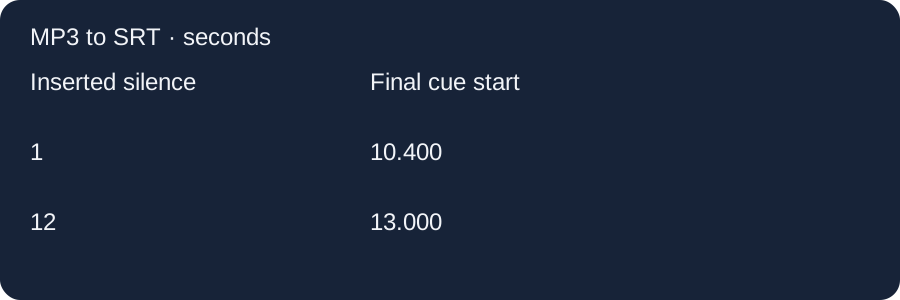
We concatenated the same two original FLAC excerpts twice. Between the first and second excerpts we inserted one second of silence for the short file and twelve seconds for the long file. Both receive one second of trailing silence and the same mono 22050 Hz, 96 kb/s MP3 encoding. No speech was synthesized or sped up. The source and edits are recorded in the manifest; original inputs are available as first FLAC and second FLAC. This is an adaptation of the cited recordings; attribution does not imply endorsement.
| Input | Inserted middle silence | MP3 duration | Final cue | Exported cues |
|---|---|---|---|---|
| Short pause | 1 s | 12.671519 s | 10.400–11.300 s | 3 |
| Long pause | 12 s | 23.670023 s | 13.000–22.000 s | 2 |
Durations are FFprobe readings of the generated MP3 files. The cue times and counts are from the two actual downloads below.
Actual files and unedited SRT downloads
One-second inserted pause
Tool status: Done — 3 segments.
Download the actual MP3 input · Download the untouched SRT
1
00:00:00,000 --> 00:00:05,400
Mr. Quilter is the apostle of middle classes, and we are glad to welcome his gospel."

2
00:00:07,400 --> 00:00:10,300
Norris' "Mr. Quilter"'s manner less interesting than

3
00:00:10,400 --> 00:00:11,300
His Matter
Twelve-second inserted pause
Tool status: Done — 2 segments.
Download the actual MP3 input · Download the untouched SRT
1
00:00:00,000 --> 00:00:05,440
Mr. Quilter is the apostle of The Middle Classes, and we are glad to welcome his gospel!

2
00:00:13,000 --> 00:00:22,000
Norris Mr. Quilter's manner less interesting than his matter
What changed and what remains uncertain
The reference second excerpt begins “NOR IS MISTER QUILTER'S”; the short run renders the opening as Norris' "Mr. Quilter"'s, while the long run renders it as Norris Mr. Quilter's. Both retain the ending “his matter”, though casing and punctuation differ. The short run splits its second excerpt into two cues; the long run uses one. These are observations, not word-error rates.
FFprobe measured the first original excerpt at 5.855 seconds. In the assembly, the planned second excerpt begins after 5.855 + 12 = 17.855 seconds in the long file. Its final exported cue starts at 13.000 seconds, earlier than that planned boundary. MP3 encoding can add small timing offsets, so this calculation is an assembly reference rather than an independently measured speech onset. Replaying the file is the practical way to adjust the cue in an editor.
Changing the inserted gap changes the total file length and the second excerpt's position too. One run of each file cannot prove why the model chose different wording or timing, and the experiment does not establish a fix or guarantee for other recordings. Preserve the original export before making a corrected version.
A competing workflow and the missing check
On October 28, the English/US Google results in our signed-in Chrome listed Zamzar, TurboScribe and Converter App as the first three ordinary results; the latter page was read in Chrome. Its workflow presents file selection, automatic conversion and download, and publishes server-processing time by file-size group. It says that timing excludes upload and download. Those figures describe its servers, not this browser run.
Our earlier article compared file formats but did not isolate an inserted pause in the same spoken material. This page adds the two playable MP3 inputs, exact unchanged downloads and the gap calculation so a reader can inspect the final cue rather than assume a successful download means correct timing. We did not submit these files to any competitor, and did not compare accuracy or speed.
How to check your own file
- Keep your original recording and download the raw SRT.
- Replay the speech immediately after the long pause and compare its first and last words with the final cue.
- Compare the cue's start with the audible beginning of that speech; correct a separate working copy if needed.
- Replay the corrected subtitle in your editor. Do not add words from a script without checking the recording.
Questions about MP3 subtitles and long pauses
Did the twelve-second gap erase the ending in this test?
No: the long-gap output still includes “his matter”, although the beginning of the sentence is wrong. This one run does not predict results for other recordings.
Does Done mean the cue starts when the speaker resumes?
No: the long-gap cue begins at 13 seconds, before the planned end of the inserted silence at 17.855 seconds. Check the actual audio and adjust a working copy.
Do these two runs prove why the cue starts early?
No: each input was run once, and changing the pause also changed the total file length and the position of the speech. The output alone cannot identify the cause.
Evidence from this check: the two adapted real-voice inputs, source identifiers, raw exported subtitles, and comparison of inserted silence with the returned cue. These results are limited to this pair of files.
Return to the MP3-to-SRT tool · Compare the separate missing-ending test
MP3 TO SRT · NOISE CHECK
Can background noise cause an MP3-to-SRT export to miss words?
Answer: in our two runs, both exports missed part of the supplied reference, and the version with added white noise ended earlier. This comparison does not prove the noise caused the omissions; listen to the recording and check the entire export before using it.
On October 29, 2026, we used the live audio-to-text tool in the ChatGPT in-app browser. We selected each MP3 as a file, chose English and SRT, and downloaded the results without editing their text or timestamps.
The source and how we prepared the files
The human voice is from LibriSpeech, prepared by Vassil Panayotov and contributors and licensed under CC BY 4.0. The precise recording is 1272-128104-0004, row 4 of this validation subset. Its accompanying text is a dataset reference, not an independently checked transcript. Download the original FLAC or read our preparation manifest.
Dataset reference: LINNELL'S PICTURES ARE A SORT OF UP GUARDS AND AT EM PAINTINGS AND MASON'S EXQUISITE IDYLLS ARE AS NATIONAL AS A JINGO POEM MISTER BIRKET FOSTER'S LANDSCAPES SMILE AT ONE MUCH IN THE SAME WAY THAT MISTER CARKER USED TO FLASH HIS TEETH AND MISTER JOHN COLLIER GIVES HIS SITTER A CHEERFUL SLAP ON THE BACK BEFORE HE SAYS LIKE A SHAMPOOER IN A TURKISH BATH NEXT MAN.
We encoded the same voice twice as mono MP3 at 22,050 Hz and 96 kb/s. The second file mixes in FFmpeg-generated white noise with seed 29 and source amplitude 0.025, then applies noise volume 0.25 with the voice at volume 1; this is synthetic white noise, not a recording of a real room or music. FFprobe measured each MP3 as 29.4 seconds. The two files contain the same voice, so they do not represent two speakers or separate speech samples.
Raw inputs and exports
Voice without added noise
Status returned: Done — 4 segments.
Download the MP3 input · Download the unchanged SRT
1
00:00:00,000 --> 00:00:07,280
Lynelle's pictures are sort of upgards on atom paintings, and Mason's exquisite ittles

2
00:00:13,000 --> 00:00:19,800
escapes, smile at one much in the same way that Mr. Carcker used to flash his teeth

3
00:00:19,820 --> 00:00:25,640
and Mr. John Collier gives a cheerful slap on her back before he says like

4
00:00:25,660 --> 00:00:28,920
A shampooer or Turkish bath next man
Voice with added white noise
Status returned: Done — 3 segments.
Download the MP3 input · Download the unchanged SRT
1
00:00:00,000 --> 00:00:07,240
Lynelle's pictures are sort of upgards on atom paintings, and Mason's exquisite Ittles

2
00:00:07,240 --> 00:00:11,480
is as national a jingo poem.

3
00:00:13,000 --> 00:00:19,920
This gave Smilet one much in the same way that Mr. Carker used to flash his teeth, and

What we can and cannot say from this pair
The clean export includes the ending “A shampooer or Turkish bath next man”; the noisy export stops after “and” in its third cue. Both differ from the dataset reference and neither is a verbatim transcript. In the clean export, one cue ends at 7.280 seconds and the next begins at 13.000 seconds; a gap in cue times alone does not identify exactly which words were missed. The noisy export's final cue ends at 19.920 seconds, while the input file lasts 29.400 seconds. Cue endpoints come from the saved files, and input duration comes from FFprobe.
Each version was run once. Automatic speech recognition can vary, and this comparison does not isolate a cause, measure a word error rate, establish a noise tolerance, or predict another file. White noise is only one artificial condition. Listen to the original and do not infer missing words from an SRT timestamp alone.
What another workflow makes visible
On October 29, we read Converter App's MP3-to-SRT page. It describes selecting a file, automatic conversion and download, and publishes server processing times by file size, explicitly excluding upload and download time. That is a speed description, not a same-file transcript comparison. We did not submit these files there and cannot compare either tool's accuracy or speed.
For this page we instead show both playable inputs and both unchanged exports alongside the dataset reference. This makes an early ending and recognition errors inspectable; it is not evidence that one product is better than another.
How to check an export
- Keep the original MP3 and the downloaded SRT as separate files.
- Play the recording to its end while comparing it with the last subtitle cue.
- Replay any suspicious section and correct a copy using the audible words, not guesses.
- Check the corrected subtitles against the recording in your video editor.
Questions about MP3 to SRT with background noise
Did the noisy file produce the final words in this check?
No: the noisy SRT ended with “and” while the clean version included part of the final sentence. This is the result of one run for each file.
Can a completed export still miss a section?
Yes: both runs reported Done, but both differed from the supplied reference. Replay the recording rather than relying only on the completion status.
Does this test prove white noise always truncates subtitles?
No: one paired test cannot establish a general rule or the cause of the difference.
MP3 TO SRT · REPEATED SILENCE CHECK
Does a long silence make MP3 to SRT miss the final words?
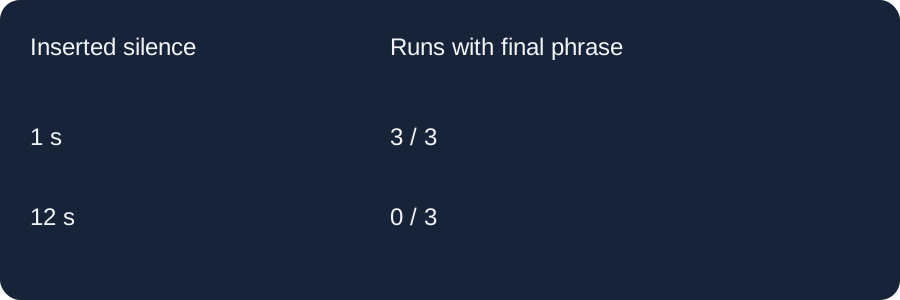
Answer: in this six-run check, all three long-silence exports stopped at “finish in art”; all three short-silence exports continued with “is adding more effect.” The reference ends “is adding more fact.” These results apply to these files and settings, not every recording.
We ran each input three separate times on the live audio-to-text tool in the Codex in-app browser, selecting English and SRT. Each section below preserves the tool status and the original download. We did not correct words or timestamps.
Same voice, one changed silence
Both files join the same two licensed human-read excerpts from LibriSpeech (Vassil Panayotov and contributors, CC BY 4.0). The identifiers 1272-128104-0006 and 1272-128104-0007 are rows 6 and 7 in this validation subset. Its supplied text is a dataset reference, not a separately verified human transcript. Preparation record · First original FLAC · Second original FLAC.
Reference first excerpt: ON THE GENERAL PRINCIPLES OF ART MISTER QUILTER WRITES WITH EQUAL LUCIDITY. Reference second excerpt: PAINTING HE TELLS US IS OF A DIFFERENT QUALITY TO MATHEMATICS AND FINISH IN ART IS ADDING MORE FACT.
We inserted one second or twelve seconds of silence between the same excerpts and appended one second of silence at the end of both files. Both were encoded as mono 22,050 Hz, 96 kb/s MP3. FFprobe reported 16.88 seconds for the short file and 27.88 seconds for the long file. The different middle silence necessarily changes the total duration and where the second excerpt starts; it is not an independent speaker or a new speech sample.
What each run returned
Short silence: three of three outputs continued through “is adding more effect.” Long silence: three of three ended at “finish in art.” All six changed the reference name “Quilter” to “Krilter”. In the short exports, “fact” became “effect”; neither spelling was edited for this page. This counts visible outcomes in these six runs, not word accuracy.
One second of inserted silence
Run 1: Done — 5 segments.
Download the unedited SRT for run 1
1
00:00:00,000 --> 00:00:06,000
on the general principles of art and Mr. Krilter writes with equal lucidity

2
00:00:07,000 --> 00:00:09,000
painting he tells us is

3
00:00:10,000 --> 00:00:12,000
a different quality to mathematics

4
00:00:13,000 --> 00:00:14,000
And finish in art

5
00:00:13,000 --> 00:00:15,000
is adding more effect.
Run 2: Done — 5 segments.
Download the unedited SRT for run 2
1
00:00:00,000 --> 00:00:06,000
on the general principles of art and Mr. Krilter writes with equal lucidity

2
00:00:07,000 --> 00:00:09,000
painting he tells us is

3
00:00:10,000 --> 00:00:12,000
a different quality to mathematics

4
00:00:13,000 --> 00:00:14,000
And finish in art

5
00:00:13,000 --> 00:00:15,000
is adding more effect.
Run 3: Done — 5 segments.
Download the unedited SRT for run 3
1
00:00:00,000 --> 00:00:06,000
on the general principles of art and Mr. Krilter writes with equal lucidity

2
00:00:07,000 --> 00:00:09,000
painting he tells us is

3
00:00:10,000 --> 00:00:12,000
a different quality to mathematics

4
00:00:13,000 --> 00:00:14,000
And finish in art

5
00:00:13,000 --> 00:00:15,000
is adding more effect.
Twelve seconds of inserted silence
Run 1: Done — 2 segments.
Download the unedited SRT for run 1
1
00:00:00,000 --> 00:00:05,000
on the general principles of art and Mr. Krilter writes with equal lucidity

2
00:00:13,000 --> 00:00:24,300
Painting, he tells us is of a different quality to mathematics and finish in art
Run 2: Done — 2 segments.
Download the unedited SRT for run 2
1
00:00:00,000 --> 00:00:05,000
on the general principles of art and Mr. Krilter writes with equal lucidity

2
00:00:13,000 --> 00:00:24,300
Painting, he tells us is of a different quality to mathematics and finish in art
Run 3: Done — 2 segments.
Download the unedited SRT for run 3
1
00:00:00,000 --> 00:00:05,000
on the general principles of art and Mr. Krilter writes with equal lucidity

2
00:00:13,000 --> 00:00:24,300
Painting, he tells us is of a different quality to mathematics and finish in art
What the result does not establish
The input pair uses one voice and the same excerpts. Repeating each condition tests this pair's repeatability; it does not demonstrate that a twelve-second pause always causes a missing ending or explain which processing stage produced it. We did not test other speakers, silence lengths, devices, languages, or competing tools. Keep the original audio, review each word against it, and inspect the end of a downloaded SRT even when the tool says Done.
Questions about silence and subtitles
Did the long-silence file miss the same ending each time?
Yes: the three saved long-silence exports all ended at “finish in art” and omitted the reference phrase “is adding more fact”. This is limited to this input and these runs.
Did the short-silence runs preserve the final phrase exactly?
No: all three included the phrase but wrote “effect” where the dataset reference says “fact”. Listen to the source before correcting it.
Can the run count predict another recording?
No: three repeats of each version are not a representative sample of speakers, files, or devices.
Return to MP3 to SRT · Read the earlier two-run silence check
MP3 TO SRT · LANGUAGE SETTING CHECK
Should you use auto-detect or English for an English MP3?
Answer: both settings produced incomplete text in our check, so review the audio against the SRT whichever you choose. Auto-detect returned two approximate time ranges in each run; English returned three timestamped cues in each run. This result covers one recording and three runs per setting.
On October 31, 2026, we selected the same MP3 in the live audio-to-text tool using the Codex in-app browser. We ran Auto-detect three times and English three times with SRT selected. We saved the actual downloads without correcting words or timing. This is not a benchmark of all English speech.
The recording and reference
The human voice is from LibriSpeech, prepared by Vassil Panayotov and contributors and licensed under CC BY 4.0. Recording 1272-128104-0009 is row 9 in this validation subset. Its supplied reference is a dataset label, not an independently verified transcript.
Dataset reference: HE LAMENTS MOST BITTERLY THE DIVORCE THAT HAS BEEN MADE BETWEEN DECORATIVE ART AND WHAT WE USUALLY CALL PICTURES MAKES THE CUSTOMARY APPEAL TO THE LAST JUDGMENT AND REMINDS US THAT IN THE GREAT DAYS OF ART MICHAEL ANGELO WAS THE FURNISHING UPHOLSTERER.
We encoded the original FLAC once as a mono MP3 at 22,050 Hz and 96 kb/s. No speech was synthesized or trimmed. FFprobe measured the input at 18.290023 seconds. Both settings used that same file; these are repeated processing runs, not six independent recordings.
Download the tested MP3 · Original FLAC · Preparation record
What the six saved files show
All three Auto-detect outputs continued through “makes a customary appeal to” and then resumed with “Angela was the furnishing upholsterer.” The supplied reference between those points contains “THE LAST JUDGMENT AND REMINDS US THAT IN THE GREAT DAYS OF ART MICHAEL ANGELO”. All three English-selected outputs ended the first cue at “what” and resumed at “And the great days of art Michelangelo was”; their last cue said “The finishing upholsterer.” These words are copied from the actual exports, including mistakes. Listen to the source when judging omissions.
Auto-detect's first cue covers zero to fifteen seconds and its second covers fifteen to 18.289 seconds; the page labels these timestamps approximate. English-selected output has three cues, with the first ending at 6.500 seconds and the next starting at 13 seconds. A timestamp gap alone does not prove exactly where a word occurred; the reference and playable audio let you check it.

Auto-detect
Run 1: Done — 2 segments. Auto-detect timestamps are approximate; select a language for more precise timing.
1
00:00:00,000 --> 00:00:15,000
He laments most bitterly the divorce that has been made between decorative art and what we usually call pictures makes a customary appeal to

2
00:00:15,000 --> 00:00:18,289
Angela was the furnishing upholsterer.
Run 2: Done — 2 segments. Auto-detect timestamps are approximate; select a language for more precise timing.
1
00:00:00,000 --> 00:00:15,000
He laments most bitterly the divorce that has been made between decorative art and what we usually call pictures makes a customary appeal to

2
00:00:15,000 --> 00:00:18,289
Angela was the furnishing upholsterer.
Run 3: Done — 2 segments. Auto-detect timestamps are approximate; select a language for more precise timing.
1
00:00:00,000 --> 00:00:15,000
He laments most bitterly the divorce that has been made between decorative art and what we usually call pictures makes a customary appeal to

2
00:00:15,000 --> 00:00:18,289
Angela was the furnishing upholsterer.
English selected
Run 1: Done — 3 segments.
1
00:00:00,000 --> 00:00:06,500
He laments most bitterly the divorce that has been made between decorative art and what

2
00:00:13,000 --> 00:00:15,960
And the great days of art Michelangelo was

3
00:00:16,000 --> 00:00:18,000
The finishing upholsterer.
Run 2: Done — 3 segments.
1
00:00:00,000 --> 00:00:06,500
He laments most bitterly the divorce that has been made between decorative art and what

2
00:00:13,000 --> 00:00:15,960
And the great days of art Michelangelo was

3
00:00:16,000 --> 00:00:18,000
The finishing upholsterer.
Run 3: Done — 3 segments.
1
00:00:00,000 --> 00:00:06,500
He laments most bitterly the divorce that has been made between decorative art and what

2
00:00:13,000 --> 00:00:15,960
And the great days of art Michelangelo was

3
00:00:16,000 --> 00:00:18,000
The finishing upholsterer.
How to use this comparison
- Download the SRT and keep the original MP3.
- Replay the recording from beginning to end against the exported text.
- Check any missing phrases and names by listening, then correct a separate working copy.
- Check cue placement in your editor; automatic-mode ranges are approximate.
Each setting returned the same text across its own three runs. That does not prove another file, voice, browser, or language will behave the same way. We did not run competitors on this file and do not claim a relative accuracy or a cause for the missing words.
Choosing settings before a run
TurboScribe's MP3-to-SRT page presents audio language as a separate choice alongside its processing options. Our tool also lets you choose a language, but it does not offer that page's speaker-recognition or audio-restoration controls. We did not send this recording to TurboScribe or test its output, so this is a workflow comparison, not a quality ranking.
- Choose the saved MP3 and select SRT as the output.
- Use English when you know the speech is English, or choose Auto-detect if you do not know the language.
- After downloading, listen through the entire recording and compare both the beginning and end with the SRT. If the page says some timestamps are approximate, adjust them against the audio before publishing.
Follow-up: the same file after a local processing change
After the six earlier runs, we tested a change in a local preview on the same MP3. Both settings returned the previously omitted words “last judgment” and continued to a version of the ending, but still misheard other words. These are the actual preview downloads, not the earlier six results. One cue spans the full recording and the tool warns that its timing is approximate. The earlier exports remain above as a record of the earlier version.
Local preview: Auto-detect SRT
Download the unedited preview SRT
1
00:00:00,000 --> 00:00:18,289
He laments most bitterly the divorce that has been made between decorative art and what we usually call pictures. Makes a customary appeal to this last judgment, it reminds us of an indigrate day's arc Michelangelo was furnishing a posterer
Local preview: English SRT
Download the unedited preview SRT
1
00:00:00,000 --> 00:00:18,289
He laments most bitterly the divorce that has been made between decorative art and what we usually call pictures. Makes a customary appeal to this last judgment, it reminds us of an indigrate day's arc Michelangelo was furnishing a posterer
This follow-up does not prove that longer recordings or other speech will be complete. In a separate longer test, missing words still occurred; review the entire file.
Long interview: transcript omissions
We tested the same 24-minute 32-second NASA interview using English and compared our actual SRT with TurboScribe's Whale-mode transcript and NASA's published transcript. Times below are approximate and need checking against the audio; the published transcript may be edited.
| Approximate time | NASA published reference | Our SRT | TurboScribe | Difference |
|---|---|---|---|---|
| 13:52–13:57 | “the hands and the eyes” | “the hands” / “and eyes” | “the hands and the eyes” | Our output omits “the” before “eyes”. |
| 14:06–14:15 | “and that is a huge, huge boost” | “and that” / “boost to what we're doing” / “what we're doing and the future” | “And that is a huge, huge, huge boost” | Our output omits “is a huge, huge”; TurboScribe includes an additional “huge” compared with NASA's published transcript. |
These are examples from one test, not a measurement of overall quality. Our exported SRT contains overlapping timestamps; review the audio and timing before using the subtitles.
Questions about language settings for MP3 to SRT
Did manually selecting English prevent omissions in this test?
No: all three English-selected outputs omitted part of the supplied reference. Review the audio even if the status says Done.
Are auto-detect subtitle times exact in this test?
No: the tool explicitly labels auto-detect timestamps approximate, and these exports use segment ranges.
Were the six outputs six different recordings?
No: they are six runs of the same encoded MP3, with only the language setting changed between groups.
Return to MP3 to SRT · Read the separate repeated-silence test
By ReelScriptly · Last content update: